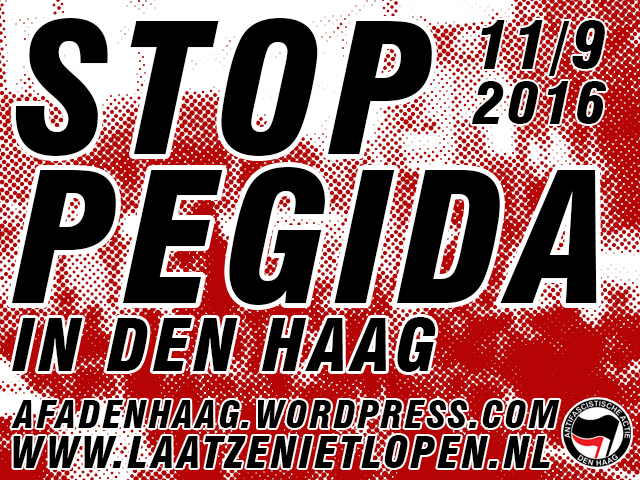
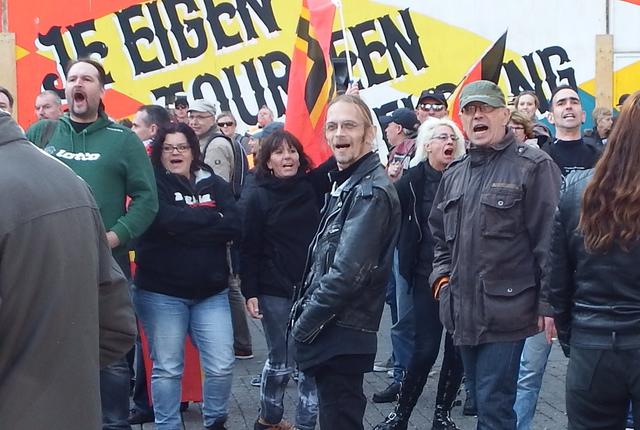
Aanstaande zondag (9 oktober 2016) wil de extreem-rechtse beweging Pegida Nederland weer demonstreren in Den Haag. Wij hebben besloten om bij deze demonstratie slechts een minimale informatiestructuur op te zetten. Als mensen toch van plan zijn in actie te komen tegen Pegida dan moedigen wij dat uiteraard van harte aan. Voor deze mensen hebben wij aanstaande zondag wel een arrestantengroep en een advocaat paraat staan.
De arrestantengroep is vanaf 13:00 bereikbaar op telefoonnummer 06 43 13 69 45. De advocaat die paraat staat is Ineke van den Brûle van advocatenkantoor Prinsegracht 53.
Pegida verzamelt vanaf 14:00 uur op de Koekamp, naast het Centraal Station in Den Haag. De gemeente heeft Pegida inmiddels laten weten dat zij niet meer welkom zijn in het centrum. De demonstratie loopt richting het Ministerie van Buitenlandse Zaken, en vanaf daar meteen terug naar de Koekamp. Acties van anti-fascisten hebben er van begin af aan voor gezorgd dat de ruimte voor Pegida erg klein is gebleven. Ook nu kan Pegida slechts een heel klein rondje lopen en worden ze uit het centrum geweerd.
Wij blijven Pegida met een scherp oog volgen. Het is nu al bekend dat Pegida van plan is om ook op 13 november en 11 december in Den Haag te demonstreren. Houdt voor nieuws over tegenprotest en informatievoorziening daarover de komende tijd onze website, Facebook en Twitter goed in de gaten.
Op zondag wil het extreem-rechtse Pegida voor de tweede keer demonstreren in Den Haag om zo hun verwerpelijke racistische gedachtegoed te verspreiden. Pegida wil vanaf de aanstaande demonstratie maandelijks in Den Haag demonstreren. Laat Ze Niet Lopen, een initiatief tegen racisme en extreem-rechts, roept op om in actie te komen tegen deze racistische optocht. Blokkeer, saboteer en overstem de demonstratie van het racistische Pegida! Laat Ze Niet Lopen!
Pegida is een van origine Duitse racistische beweging. Hun demonstraties bestaan dan ook bijna geheel uit extreem-rechtse figuren en neo-nazis van groepen als het fascistische Voorpost en de neo-nazi partij de NVU. De leider van Pegida, wapenhandelaar Edwin Wagensveld ging afgelopen zomer nog op vluchtelingenjacht in Bulgarije samen met Bulgaarse neo-nazis in legeruniformen.
Alhoewel Pegida zegt tegen geweld te zijn is hun Facebook pagina een platform waar volop gewelddadige acties tegen vluchtelingen, immigranten en iedereen die niet in hun wereldbeeld worden toegejuicht. Nu probeert Pegida de weerzinwekkende aanslagen die 15 jaar geleden plaatsvonden in New York te misbruiken om hun racistische gedachtegoed te legitimeren en kracht bij te zetten. Maar racisme is nooit de oplossing, de ene verschrikkelijke daad kan niet met de ander verholpen worden.
Laat Ze Niet Lopen, een initiatief tegen racisme, roept je daarom ook op om je te verzetten tegen Pegida en zelf actie te ondernemen tegen de komst van rechts-extremistische actievoerders. Organiseer jezelf en je vrienden, fluit ze uit, overstem ze, blokkeer, laat zien dat ze niet welkom zijn! Eerdere demonstraties van Pegida zijn door toedoen van tegenacties altijd vrij beperkt gebleven. Het is aan ons om samen de druk op de ketel te houden en de ruimte voor Pegida zo klein mogelijk te houden!
De vorige keer dat Pegida in Den Haag demonstreerde werden zij beschermd door de politie en werden er 54 mensen die zich wilden laten horen tegen racisme preventief opgepakt. Juist nu dat Pegida Den Haag als nieuwe thuishaven kiest moeten we ons niet laten afschrikken door politierepressie, en moeten we nu een massaal geluid laten horen tegen Pegida en hun racistische propaganda.
De demonstratie van Pegida begint om 14:00 op de Koekamp in Den Haag waarna Pegida een demonstratie zal lopen door het centrum. Omdat ervaring leert dat de locatie van Pegida-demonstraties op het laatste moment nog kan veranderen is het verstandig om www.laatzenietlopen.nl in de gaten te houden. Ook kan je Laat Ze Niet Lopen volgen op Twitter en Facebook. In de aanloop naar, en op de dag van het tegenprotest voorzien wij in de laatste informatie, kaartjes van de omgeving en infostructuur.
[Dit artikel verscheen in het laatste nummer van het anarchistisch kwartaalblad ‘Buiten de Orde‘, een uitgave van de Vrije Bond]
Het laatste jaar roeren extreem-rechtse groepen zich steeds harder in Nederland. In eerste instantie gevoed door de ophef rondom de komst van vluchtelingen en alom aanwezige islamofobie organiseren ze zich, lopen ze demonstraties, uiten ze zich online en gaan ze soms ook over tot gewelddadigere acties. Het gaat om diverse bestaande partijen en organisaties als de NVU en PVV, maar ook om nieuwe clubjes. Waar komen deze groepen vandaag, en hoe kunnen we hen als antiracisten bestrijden?
Op 11 oktober 2015 hield de Nederlandse afdeling van Pegida haar eerste demonstratie. Pegida is een oorspronkelijk Duitse organisatie die zich richt tegen de islam en vluchtelingen, en acties voer vóór het behoud van de zogenaamde “Duitse identiteit”. In Duitsland brengt deze beweging grote groepen mensen op been, en zoals wel vaker met rechts-extremistische groeperingen wordt er dan in Nederland ook een poging gedaan om in Nederland ook een dergelijke beweging op te bouwen.
Dat opbouwen van een grotere organisatie naar inspiratie van buitenlandse voorbeelden is sinds de NSB nooit echt gelukt. Een paar jaar geleden nog probeerde men een aantal keer een Nederlandse kopie van de English Defence League te beginnen. Deze hooligan-achtige club houd in Engeland al enige tijd redelijk succesvolle (en gewelddadige) demonstraties, maar Nederlandse pogingen strandden al na korte tijd.
De eerste demonstratie van Pegida Nederland kreeg volop aandacht van de pers. De Duitse voortrekkers waren immers vrij succesvol, en ook in Nederland zijn islamofobie en vluchtelingenhaat aan de orde van de dag, en kunnen deze op internet op veel steun rekenen. Daarnaast werd deze demonstratie georganiseerd door Edwin Wagensveld, een Nederlandse wapenhandelaar die al veel ervaring op had gedaan bij de Duitse Pegida. Kortom: men verwachtte nogal wat.
Uiteindelijk kwamen ruim 200 mensen opdagen, naast hooligans, veel Duitse Pegida aanhangers en wat ‘bezorgde burgers’ ook veel activisten van diverse extreemrechtse en neonazistische actiegroepen en enkele oudgediende rechtsextremisten van de CD. Door het agressieve gedrag van de hooligans en rechts-extremistische beroepsdemonstranten liep de demonstratie al snel uit de hand. Hierna werd het plein waarop Pegida stond volledig afgesloten door de politie waardoor niemand nog iets van hun actie mee kon krijgen.
Ondanks deze tegenvaller liet Pegida zich niet ontmoedigen, en organiseerde men de afgelopen maanden nog meerdere demonstraties. De opkomst is echter nooit meer zo hoog geweest, en bij de meest recente demonstratie van Pegida waren nog ongeveer 80 mensen aanwezig. Het gaat dan vooral om mensen die bij elke demonstratie aanwezig zijn, met weinig lokale opkomst.
Pegida moet het dus vooral van steeds dezelfde groep extremisten hebben, en het lukt ze niet om met hun demonstraties een breder publiek aan te trekken zoals in Duitsland. Dit werd ook nog eens pijnlijk duidelijk toen Pegida samen met buurtbewoners een actie wilde organiseren tegen een opvang voor vluchtelingen in de Haagse wijk Ypenburg. Hier lieten de buurtbewoners het tot hun onvrede vooral afweten en waren het vooral weer veel bekende Pegida-aanhangers die op kwamen dagen.
Een volledig nieuwe groep is DTG, dat begon als een lokaal initiatief in de Enschedese wijl Dolphia maar inmiddels haar vleugels heeft uitgeslagen en nu staat voor Demonstranten Tegen Gemeenten. De aanhang bestaat uit een samenraapsel van ‘boze buurtbewoners’, hooligans en veteranen uit de neo-nazistische hoek. DTG kwam onlangs weer in het nieuws omdat een aanhanger betrokken zou zijn bij het gooien van brandbommen naar een moskee waar op dat moment diverse mensen, waaronder kinderen aanwezig waren. Wonderwel vielen er geen slachtoffers. Vanwege allerlei interne strubbelingen en ruzies (niets nieuws onder de zon) is DTG inmiddels uiteen gevallen in meerdere groepjes.
Naast deze nieuwe actiegroepen ontstaan er ook allerlei lokale initiatieven tegen de komst van vluchtelingen. Deze lijken vaak spontaan, maar er staan diverse uiterst rechtse partijen klaar om hier zieltjes te winnen en invloed uit te oefenen. Zo stuurt de neo-nazistische NVU leden naar lokale bijeenkomsten en gemeenteraadsvergaderingen, roept Geert Wilders op om in verzet te komen.
Dat in verzet komen doen veel van zijn aanhangers met het nodige geweld. De lijst met incidenten is helaas veel te lang op hier op te noemen, maar het gaat om bedreigingen, het ingooien van ruiten, het bestormen van een noodopvang etc. Zie ook het artikel “PVV aanhangers op oorlogspad” op de website www.kafka.nl
De grens tussen de “bezorgde burger” en de gewelddadige rechtsextremist lijkt steeds meer te vervagen. Een mainstream politicus als Geert Wilders roept al jaren op tot discriminatie en uitsluiting, en nu zijn aanhangers overgaan tot het plegen van geweld gooit hij er nog een schepje bovenop. Buurtbewoners aarzelen niet om samen te werken met extreem-rechtse activisten en clubjes, en demonstreren zij aan zij met hooligans.
Het gaat gelukkig nog wel om een kleine groep die de laatste stap naar het rechtsextremisme zet. De optochten van Pegida blijven toch hangen in de marge, en nieuwe clubjes als DTG gaan ten onder aan onkunde en onderlinge verdeeldheid en geweld.
Qua retoriek lijkt men echter elkaar te willen overstemmen met steeds extremere standpunten. In de mainstream politiek is Wilders nog steeds het meest uitgesproken, maar ook andere politici van verschillende partijen zien hun kans schoon om olie op het vuur te gooien. Aantoonbaar onware uitspraken worden aan de lopende band de media in geslingerd om het vuur van de vluchtelingenhaat nog wat aan te wakkeren, en ministers erkennen het bestaan van een “Marokkanenprobleem” in het voetbal waarvan de KNVB zegt dat het er niet is.
Er zijn in Nederland geen mainstream ‘linkse’ partijen of sociale bewegingen van enige omvang die een duidelijk antiracistisch standpunt innemen. Maar ook op economisch vlak is er nauwelijks een serieus alternatief voor neoliberale afbraakpolitiek. Een gat waar de PVV handig in probeert te springen door te zeggen dat zij wél opkomen voor ouderen, pensioenen en banen.
Uiteraard biedt de PVV geen daadwerkelijk economisch alternatief. Hun zondebokpolitiek en racisme negeren dat het vooral witte mannen zijn die verantwoordelijk zijn voor de economische afbraak, en dat moslims en vluchtelingen daar vooral slachtoffer van zijn. Maar hun holle retoriek vind wel enige weerklank in een maatschappij waar economische afbraak niet te stoppen lijkt.
Deze economische dimensie zou deels het succes van de PVV kunnen verklaren, maar de diverse rechtsextremistische splintergroepjes en lokale grassroots anti-vluchtelingen clubjes kennen deze economische dimensie niet of nauwelijks. Het voert veel te ver om in dit artikel diep in te gaan op alle factoren die een voedingsbodem bieden voor dit soort clubs, maar duidelijk is wel dat alleen wijzen naar een economische oorzaak of alléén naar diepgeworteld racisme en discriminatie in de samenleving geen rechts doet aan wat we nu om ons heen zien gebeuren. En met alléén een economisch alternatief zijn we als links nog niet bij een antwoord, daarbij moeten we ook een breed en solidair antiracisme organiseren.
Tijdens de acties van onder andere Pegida is er gelukkig ook een groeiend tegengeluid te horen. Mensen gaan de straat op om te laten zien dat dit soort haatzaaien niet welkom is, en soms honderden mensen proberen om deze rechts-extremisten te overstemmen. In de gevestigde politiek is het echter vooral stil. Dat is voor de meer doorgewinterde antiracist natuurlijk niets nieuws, politieke partijen zijn zelden of nooit onze bondgenoot geweest. Maar hoe een partij als de PVDA probeert om het haatzaaien van Wilders te counteren met een enorme lading vooroordelen en verdachtmakingen ten opzichte van vluchtelingen is desondanks misselijkmakend.
Het echte verzet tegen de hierboven geschetste ontwikkelingen zal, zoals eigenlijk elk daadwerkelijk verzet ook nu weer van onderop moeten komen. Alleen door zelf in actie te komen, landelijk maar zeker ook lokaal, op internet, overal eigenlijk kunnen we dit soort haat een tegenwicht bieden. En om dat tegengeluid meer weerklank te laten vinden en daadwerkelijk succesvol te laten zijn, moeten tegelijk werken aan een geloofwaardig economisch alternatief.
[This article was published on Libcom.org earlier this summer. It was written as an introductory lecture for (non-Dutch) antifascist activists at the annual “Alerta! Alerta! Festival” in Amsterdam, the Netherlands and maps the general history of Dutch fascism and the militant antifascist response against it.
The author has been active for nearly 20 years in militant anti-fascism in Amsterdam, the wider Netherlands and abroad.
Non-commercial redistribution is allowed and encouraged. The author can be contacted through afaamsterdam[at]riseup.net]
[Dit artikel verscheen eerder deze zomer op Libcom.org. Het is geschreven als een inleidende lezing voor (niet-Nederlands sprekende) antifascisten op het jaarlijkse “Alerta! Alerta! Festival” in Amsterdam, en brengt de algemene geschiedenis van het Nederlands facisme en de militante antifascistische respons daarop in kaart.
De auteur is al zo’n 20 jaar actief binnen het militante antifascisme in Amsterdam, Nederland en daarbuiten.
Niet-commerciele verspreiding is toegestaan en wordt aangemoedigd. De auteur kan worden bereikt via afaamsterdam[at]riseup.net] A radical history of the struggle against fascism in Holland since the early 20th century, written by member of the Dutch section of Anti-Fascist Action.
The birth of the Dutch radical left
Although, obviously, terms like fascism and anti-fascism only came into use in the period between World War 1 and World War 2, their roots are firmly found before World War 1. Just as present day fascism still has its origins in the rise of nationalism and national identity we have to, if only briefly, examine the early history of the Dutch radical left before we can have a meaningful talk about how she developed through the last century.
The Dutch, and especially the Amsterdam proletariat had a long tradition of rioting and mob action. Because of being built in a literal swamp, where reclaimed land was a precious commodity, the Amsterdam slums in the Jordaan, Nieuwmarkt and Oostelijke eilanden where often literally only a stone throw away from where the rich and powerful where living. So in times of economic upheaval it was quite common for mobs of young workers to go out on the canals and attack and plunder the houses of the rich. Revolts where in general short lived, spontaneous and unorganized but violent outbursts of class anger. As illiteracy was still the norm agitation mostly took the form of mouth-to-mouth incitement and the occasional spread of printed and wheat pasted screeds with mostly scandalous gossip and satiric cartoons.
During the revolutionary year of 1848 the first relatively coherent socialist ideas where introduced in Amsterdam by a tight knit group of German craftsmen. Though there was, again, only a flash in the pan riot on the 24th of march of that year followed by violent repression, this moment is seen as the birth of the Dutch socialist movement as the mob came together after instigation by the German group who planned a political demonstration, but to their own surprise got looting and fighting in the finest Amsterdam tradition instead.
The uneasy alliance between the often incoherent and spontaneous tradition of Amsterdam prole mob action and the attempts, by often German born educated, skilled craftsmen to form socialist and syndicalist organisations would be a defining feature of the Dutch radical lefts early history.
The Sociaal Democratische Bond was started in 1881 as the first socialist political party in the Netherlands and was led by the former protestant preacher Domela Nieuwenhuis.
Its main focus was universal suffrage and, later, the right to syndicalist self-organisation of workers.
Already in 1896 the “revolutionary/anarchist” faction under Nieuwenhuis, which stood very much in the insurrectionary tradition of the early Amsterdam prole revolts, split off and left parliamentarism altogether while the remainder of the party, again strongly dominated by often Jewish, German born, higher skilled workers, would eventually form the Sociaal Democratische Arbeids Partij (SDAP). This party consequently would later split in a reformist faction that would over time become today’s new-labour Partij van de Arbeid (PVDA) and an orthodox Marxist faction that would become the prominent but now no longer existing Dutch communist party CPN. I could have a whole separate talk about this subject (for those that can read Dutch I strongly recommend the book “waarachtige volksvrienden” by Dennis Bos) but a important aspect to keep in the back of our heads from this is that the “anarchist/free socialist” movement that thus formed was fiercely pacifist (not in the today hippie sense of the word but as in principled rejection of militarism) while the Marxist movement later had a minor but comparatively to the surrounding countries very strong, internationalist council-communist faction.
The inter war period, the rise of fascism and the Spanish civil war
The first Dutch fascist political party was formed in 1923 and was called the Bond van Actualisten. It was inspired on the Italian fascist movement but didn’t manage to make much headway. Dutch politics remained dominated by the bourgeois religious and liberal parties with the socialist workers movement in opposition.
Both the Religious parties and the Liberal Party had strongly anti-democratic and hyper nationalist views though. The first Dutch political party ever formed was even called the “Anti-Revolutionary Party” (ARP) to press its Calvinist and anti-French revolution founding principles.
The first fascist party that had a meaningful amount of success was the Nationaal-Socialistische Beweging (NSB) which was formed in 1931 and at its pre-war peak in 1936 had 50.000 members, the party saw a fast and steady decline though until the Nazi invasion in 1940 of the Netherlands and while getting a lot more members during the war this where mostly opportunists and few true believers.
While the Netherlands managed to remain neutral during World War 1 the period saw again a strong influx of German, often Jewish, radicals fleeing their country, which left a strong mark on the Dutch radical left, the same happened during Hitler’s rise to power.
The start of the Spanish civil war in 1936 had a strong impact on the Dutch left but because of the dominance of the pacifist current in the anarchist movement and the rejection of cross class anti-fascism by the leading ideologues of the council-communist movement almost all volunteers that left for Spain took part in the by the Comintern organised International Brigades. Even though many of the Dutch volunteers, because of their anarchist or council-communist ideas maybe would have felt more at home at the more libertarian factions in the revolution.
About 700 Dutch volunteers took part in the international brigades (including for example two of the older brothers of my own grandpa, one of which died) of which about 300 survived their ordeal at the front and in the Franquist concentration camps. Most volunteers that fought on the republican side that did return had their Dutch citizenship revoked by the Dutch government.
While many communist and Jewish radicals had a good idea of what was coming, experienced as they where with the fascist threat through their time either in Spain or in support work from the Netherlands, the broader Dutch society expected that they, again, could remain neutral in the upcoming war. Frustrated by the cowardly response both here and in Germany the Dutch council-communist Van der Lubbe tried to agitate the people into anti-fascist resistance by starting the Reichstag fire in Berlin.
A courageous act even though the Nazi’s would seize on it to unleash their persecution of the German communist movement and one he would pay for with his life by getting executed by guillotine.
My own great-grandpa, having already lost a son to fascism, wrote a letter to the main Dutch newspaper in 1939 that I think summed up the mood in the Netherlands towards fascism quite accurately; fascist where a minority but bold, the left was on the back foot but willing to put up a fight, the police and other officials would collaborate and most of the public didn’t like the fash but would go not so far to stand up for their fellow Dutchmen that they would put themselves in danger.
The letter translates as;
Quote:
“Nazi method’s?
Wednesday morning at ten past eight I was standing besides my bicycle before the crossing on the Rozenstraat in Haarlem. Next to me there was a tall, blond gentleman who loudly blew the “horst wessel song” in my ear. This I didn’t appreciate and I told him calmly that we were here not in Germany and that it would be at least another 14 days before we would. To which the man hit me my glasses of my face and shouted that he doesn’t talk with Jews, Jews should only be disciplined. Filthy Jews like me belonged in Palestine etc. etc. I collected the broken pieces of my glasses and requested the traffic police officer, under who’s eyes this whole thing unfolded, to make a report about what happened. But the officer assured me that he was not allowed to do this because he was not qualified to do so.
At the entrance of the station the anti-Semite, who like me takes the train to commute, tried to slam the door in my face, which I luckily could narrowly avoid.
On the platform he claimed I was following him around and “ordered” me to leave the platform. This all in the usual anti-Jewish-Goebbels-jargon. The station staff could prevent a new assault by standing close to him and laughing out loud.
I have filed a complaint at the police.
Jaap Polak”
Not even half a year later the country was indeed invaded by the Nazis, the newspaper he wrote this to was actively collaborating with the Nazi occupation and my great grandfather, after first joining the communist resistance, perished in 1942 in Auschwitz.
World War 2
The Dutch nowadays like to lay claim to supposed fierce and broad resistance against the Nazi’s but when the Nazi’s invaded actually most of the Dutch remained very passive or even actively collaborated with the Nazi’s.
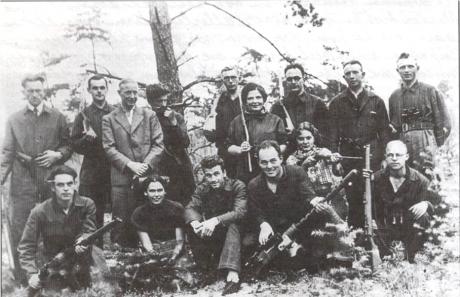
Only the strong Dutch Communist Party tried to reorganise themselves from the start underground. An early success was the famed Amsterdam February strike of 1941. This near general strike had its origins in retaliatory mass deportations of Jews that followed armed resistance by Jews and communists against several anti-Semitic attacks by the WA (which was the uniformed SA brown shirt clone of the NSB) on the Jewish population of Amsterdam. This self-defence left one Nazi dead and several others severely injured. In one of these incidents the Jewish staff and customers of a ice-cream shop called Coco in the van Woustraat that got harassed before, used ammonia gas (which was used to cool the ice-cream) to defend themselves against the brown shirt attack.
When spontaneous calls for a protest strike started to get spread around in Amsterdam (where the majority of Dutch Jews lived) the communist party got involved in an attempted to show its strength. Sadly after only 2 days the strike got crushed before it could spread to most of the rest of the country. Even though the CPN itself was in part responsible for this defeat because they called for an end of the strike after these first two days, the persecution of the Dutch communist party by the Nazi’s began from that moment in earnest. The February strike remains though the only openly and large-scale act of broad and popular resistance against the Nazi persecution of Jews in the west of Europe. By far most of the resistance work during the occupation revolved around agitation through underground publications and the solidarity work for those that had to go underground (in the early days this where mostly known communists and Jews but later also thousands of working age males that didn’t want to be sent into forced labour in the German weapons factories). These people depended on a intricate covert network to supply thousands with shelter, fake id’s, food stamps and medicine without the Germans catching on. At first it was only the communist CPN that organised armed self-defence and sabotage groups to supplement these support structures, later also non-communist resistance groups formed so called “Knokploegen” and armed cells. But until the last years of the occupation those where mostly in place for robberies of food stamp distributors and the unavoidable assassinations of traitors and collaborators.
Unlike countries like France, Poland, Italy and what would later become Yugoslavia the Netherlands didn’t have a real partisan like resistance. There was not enough support nor geographical suitable conditions for such a form of resistance and as any armed resistance actions where followed by very brutal retaliatory actions by the Nazis the resistance groups where forced to weigh the consequences of each armed action very carefully.
A resistance action worthy to mention was the attack on the Amsterdam “volksregister”, the Dutch had an intricate census system which not only mentioned names, ages, family and living places but also whether people where Jewish, Roma, etc. etc. This system was, next to the massive collaboration by the middle and upper class, the reason that more than 75% of the Dutch Jews (110.000 people) could get murdered by the Nazi’s in the death camps. In march 1943 an Amsterdam resistance group, mostly made up out of artists, fire bombed the local bevolkingsregister. Though they succeeded the results where not as significant as they expected, and a few days later the whole group got betrayed and arrested. The final words of the openly gay artist and author Willem Arondues before his execution as punishment for his involvement in the attack where “Let it be known that homosexuals are not cowards.”
In the end days of the war the Dutch resistance was forcibly centralised by the government in exile and the royal family that fled to London at the outbreak of the invasion. The Communist party, which gathered enough support through their principled position throughout the war to make the other parties and the royals fear a communist takeover after the liberation, resisted as they didn’t trust the leadership of the former Nazi party member and husband of the queen Prince Bernhard. They where proven right when in the final days of the occupation much of the communist resistance in the region of Amsterdam and Haarlem got sold out by the royalist “resistance” to the Nazi’s and executed, in some cases even after the formal surrender of the Nazi’s.
Obviously life for the Dutch fascist movement was very different during the war, after the invasion most Dutch parties got banned except the collaborationist Nederlandse Unie (who had the support of about 1 million Dutch), the national-socialist NSB (who would have about a 100.000 members throughout the war) and a few smaller fascist parties.
In 1941 also the Nederlandse Unie got banned and only the NSB remained. While the NSB was from the start based on the German Nazi party program (although at its founding minus the overt anti-Semitism) it was firmly middle-class and petit-bourgeois and it where the smaller, before the war on Italian fascism orientated, parties that supplied most of the Dutch SS volunteers under the leadership of Dutch SS leader Feldmeijer. While about 25.000 Dutch would volunteer in the SS most of these Dutch SS volunteers would later be wiped out at the eastern front. Because of this and the general “don’t ask, don’t tell” about who did what in the war attitude the Netherlands, unlike for example Belgium, didn’t have a very open SS veterans movement after the war, most war criminals that got prosecuted where also more collaborationist officials, police officers and petty criminals that got employed as Jews and resistance fighters hunters.
While the NSB leader Mussert did get a honnary position after the invasion, the Netherlands where directly administrated by the German Nazis as an occupied territory and Mussert was hardly taken serious by the new regime. Mussert tried to convince the Germans to allow him to lead a united Dutch/Flanders great “Dietsland” as a federalist state in the new German empire but was sidelined quickly. The only NSB’r who did manage to acquire a real position of influence was the pre-war NSB member of parliament Meinoud Rost van Tonningen who’s widow would later form an important rallying point in the Dutch post-war neo-fascist and neo-Nazi movement until her long overdue death in 2007.
Aftermath World War 2
After the liberation all fascist and neo-fascist parties where banned in the Netherlands. But as before the war many of the non-leftist parties contain strong authoritarian and hyper nationalist currents and many collaborationist politicians and even former NSB and SS members could in some cases join the establishment parties.
Much of the non-communist “resistance” that got important posts in the post-war administration was not much better when it came to democracy and anti-fascism. Several former members of the royalist resistance tried to organise the overthrow of the Dutch social-democratic/catholic coalition government and to install a military junta under the leadership of Prince Bernhard under the excuse of anti-communism and to prevent the independence of the Dutch colonies in South East Asia.
After the failed but very brutal anti-independence war in Indonesia which ends in 1949 with already 160.000 dead, the Dutch later support the genocidal coup of Suharto in 1965 that would claim the lives of up to 3 million more Indonesians suspected of communist sympathies and Dutch military and political figures with a world war 2 history where even still involved in the military coup of 1980 in Surinam.
In the Netherlands itself there are several attempts by former collaborators and NSB members to restart a fascist party but while some social organisations are tolerated actual political organisations are effectively repressed by the state.
Boer Koekoek
The first extreme-right member of parliament outside of the established parties is Hendrik Koekoek from the populist extreme right “Boerenpartij”, so named as its started by farmers but is soon also popular by the middle class. The party enters the Dutch parliament in 1963. The origins of the party itself where firmly in the several aborted attempts to re-establish the NSB and after a spectacular rise in the senate elections of 1966 that is also the reason that the party goes down in flames again as it turn out several of their candidates have a history with the NSB or even the SS. Its worthwhile to mention this party though because while having those roots, the party, in contrast to what would follow in the 70’s and 80’s, can, if not in political positions at least in public image, very well be seen as more of a precursor to the current day populist extreme right and less as a traditional neo-fascist/neo-Nazi thuggery outfit.
70’s and 80’s, the CD/CP86 vs. the Autonomen
The oldest, still functioning today, Dutch neo-fascist party is the Nederlandse Volksunie (Dutch peoples union or NVU) which was started in 1971 in an attempt to get “eerherstel” (honour restoration) for war criminals. When the party is taken over by Joop Glimerveen in 1974 the focus shift to opposition against the arrival of Surinamese people after the independence of that country and Turkish and Moroccan labour migrants. This was the essential development to make the extreme-right in the Netherlands acceptable again under a sizeable minority of the Dutch population and would set the main talking point for the Dutch extreme-right ever since.
While the party has some moderate electoral success the Centrum Partij who manages to get a first, single seat in parliament in 1981 soon eclipses them. The party claims to be 3th way “neither left nor right” (hence the name Centre Party) but is clearly an extreme-right party with a strong neo-fascist current. Infighting between a faction around parliamentary leader Janmaat and the rest of the party leads to a split in 1984. The faction around Janmaat starts the Centrum Democraten. The other faction would, after a bankruptcy of the Centrum Partij in 1986, reorganise in the CP’86.
The newly formed Centrum Democraten faired in national elections much better than the increasingly radical and neo-nazi CP’86 I will get to in a moment. Janmaat and his CD managed to keep at least 1 seat in the national parliament up until 1998 and for a few years they even had 3 seats, an unprecedented result in the Netherlands for what was considered a one issue anti-immigrant party. In one poll he was even projected to get 10 to 15 seats but Janmaat made some serious fuck ups in PR moments that destroyed that momentum.
In 1990 they got in total 11 seats in the local elections. In some white working-class districts of Amsterdam they even got 25% of the vote. Janmaat was a very difficult person to work together with though, the party lacked capable organizers and both in parliament as in local governments they where treated as toxic with often the whole of the other parties leaving the room when Centrum Democrats would start a speech.
CP’86 was a whole different kind of beast. Already started by the neo-fascist hard-liners in the Centrum Partij in 1990 it became the political home of the blooming neo-Nazi skinhead movement when the then recently banned Jongeren Front Nederland (JFN) took over the party. From 1992 to 1996 the party had a relatively big success when, among others, the comparatively capable Tim Mudde, a Nazi skinhead who would become also the singer in the biggest Dutch Nazi OI! band Brigade Mussert (now called Brigade M), was part of its leadership. Tim Mudde is still active to this day. He now claims to be a national anarchist and tries to latch on to the vegan and animal rights movement. Under the wings of him and other openly neo-nazi’s the party conquered 11 seats in 9 local governments and started to use the white power cross as its party symbol.
In 1998 the CP’86 party was banned as a “criminal organisation” but by then party already lost most of its supporters because of infighting over the lucrative party seats, stolen party funds, drug abuse and criminal convictions for racist violence by most of the leaders.
While they in general don’t have much hope in actual electoral success or even reject electoral strategy outright most Dutch Nazi’s remain active in political parties because political parties are harder to outlaw. But the Netherlands also saw since then several extreme-right groups that organise either sub-culturally or as action groups.
The most prominent subcultural groups are various splits and sections of the Blood and Honour Network (in the Netherlands started under the name Houd Kontakt). These subcultural groups where and are mostly Nazi skinhead drinking circles but many of the same faces also show up at extreme-right demonstrations and as supporters of fascist parties. Others progressed over time into underground would-be terror groups inspired on the English Combat-18. In many of these groups the still active veteran neo-Nazi’s Eite Homan from Groningen and Ed Pollman from Rotterdam where and are involved. These Nazi action groups like the JFN and the ANS come and go often quickly though as they come under pressure from antifascists, the police and the intelligence services or cannot agree on who gets to become fuhrer and who needs to stay foot soldiers.
The rise of neo-Nazism and neo-fascism in the Netherlands coincided with the explosion of the far more numerous radical left squat movement and they took on themselves the brunt of antifascist organisation. While the neo-Nazi’s through the years themselves kept targeting the political party Groen Links (Green Left) as their main political enemy because they where a fusion of (among other parties) the Communist Party and the Socialist Pacifist Party it was the autonomen movement that brought the fight really to the Dutch Nazis for the first time after the war. Especially after the CD/CP’86 split violent racist violence exploded on the Dutch streets. Nazi skinheads forcibly tried to take over whole punk squats in Amsterdam, the CD had their own gun club in Amsterdam north and several people got murdered. Most infamous was the stabbing of the black 15 year old Kerwin Duinmeijer by an Amsterdam Nazi skinhead in the middle of the Damstraat. Because a cab driver didn’t want to have blood on his back-seat he refused to take him to the hospital and Kerwin bled to death at the foot of the World War 2 memorial on Dam square.
While there was until 1992 no nationwide organisation for militant anti-fascism in the Netherlands (there is the Bond van Nederlandse Antifascisten but this is mostly a Stalinist front to spread tankie politics) militant antifascist action was a regular occurrence throughout the 80’s. Most cities had their own local antifascist collectives, Nazi demonstrations faced strong counter demonstrations, there where massive blockades when extreme-right parties where installed in city hall after local elections and party meetings where regularly broken up by militant antifascists with helmets and sticks.
In 1984 there was a heavy confrontation in the small town of Boekel at the party congress of the Centrumpartij, a massive brawl was fought between the hundreds of antifascists and 300 extreme-right militants.
When two years later there was intelligence that there would be, somewhere in the Netherlands, a meeting to try to reconcile the split between the Centrum Partij and the Centrum Democraten of Janmaat people went all out to try to stop this attempt at reconciliation.
Because the antifascists expected the fash to put up a even stronger defence then in Boekel the first wave of antifascist where to be pretty seriously tooled up with helmets and sticks and such. When after a long tense day of waiting the scouts brought news that the meeting would take place at a small hotel in Kedichem everybody stormed to the buses to disrupt the meeting. While the antifascists certainly reached their goals of stopping the meeting and forever crushing the possibility of a reunited Centrumpartij the action didn’t go as planned by far. There was next to no Nazi security at the event and in the very first minutes a smoke bomb got tangled up in the curtains and the whole hotel went up in flames. The secretary (and later wife) of Janmaat had to jump through a broken window and lost her leg. The triumphant victory speech of the Maoist hard-liners of the PVK (a whole different story, I recommend watching the excellent movie “de stad was van ons” on youtube which is English subtitled) gave rise to the to this day persisting myth that the hotel was intentionally set ablaze with Molotov cocktails. While 72 people got arrested most didn’t get prosecuted because they all only arrived long after the fire started. Besides Dutch neo-fascism and neo-Nazism another important target of the autonomen movement was the racist apartheid system in south Africa. Massive blockades and sabotage actions against companies that supported the apartheid regime like Royal Dutch Shell where supplemented by firebomb attacks by the mysterious RARA (radical anti-racist action) group that did millions in damage, RARA would later progress to sophisticated (but victimless) bomb attacks on symbols of the Dutch governments anti-refugee politics before disappearing in thin air again.
Fascists meanwhile excelled mostly in typical Nazi bonehead street violence and firebomb attacks though possession of firearms was also a concern. But unlike countries like Belgium, Italy and Turkey there was not a strategy of tension effort where fascist groups where recruited into doing the dirty work of the right-wing government, only in the mid 70’s a small group of establishment connected fascists where notably involved in a failed plot to do a Gladio style false flag bomb attack on the Amsterdam subway system and the kidnapping of a green politician.
the 90’s and AFA-Netherlands
In 1992, following the re-launch of the German AFA-algemeine bundniss, the until then mostly informal and locally organised Dutch antifascists decided to organise themselves also in a national AFA network. The thus formed AFA-Nederland is a network of local autonomous groups with a national secretariat and, depending on the times, a regular or irregular national coordination meeting where all local groups send representatives too.
While some groups in smaller towns have a broader base and the founding principles are not confined to a single political ideology by far most Dutch AFA groups are firmly rooted in the local squatting autonomen/anarchist movement.
AFA groups through the years have come and gone and the national secretariat moved town a couple of times the most stable AFA groups have until this day been mostly from places that had a strong and organised squat movement like Amsterdam, Utrecht, Nijmegen and Den Haag and previously towns like Leiden and Groningen. Next to this there is the independent but related antifascist research collective KAFKA that publishes both in the now defunct AFA magazine Alert! and through their own publications.
The 90’s saw several big mobilisations against the main fascist outfits and succesful disruptions of new extreme-right initiatives. I myself got involved halfway into the 90’s. By then we mostly organised against the old but previously in the Netherlands unsuccessful neo-fascist action group Voorpost, some small splinters from the old CP, a new group called Nieuw Rechts and the revived NVU.
Voorpost is originally an organisation from Flanders and can be seen as the muscle from the then very successful extreme-right party the Flemish Block (Vlaams Blok, now called Vlaams Belang after they got convicted for racism).
From all the little groups in the Dutch extreme right this is the most classical fascist/ultra-nationalist one. Though because of the small size of the Dutch organised extreme-right many faces now active at Voorpost where previously in all out Nazi groups and former Voorposters in turn show up in Nazi groups or in “new” groups like Identitair Verzet and now PEGIDA.
The NVU became the home for most of the Dutch neo-Nazi’s after the ban of CP’86. Many of the hard-core Nazi element first tried to start a Dutch section of the in Germany banned Strasserist “Freiheitlicher Arbeiter Partei” (FAP, yes really) but when that went nowhere they did an organised takeover from the by then defunct NVU. Other more “moderate” activists would start small short-lived splinter parties like the VNN and the NNP or re-join the Centrum Democraten. The Centrum Democraten never became anything near as popular as they where in the 80’s and early 90’s though and the party disbands a few months before the death of its leader Janmaat in 2002.
A group of hardcore neo-nazi’s around Eite Homan called the ANS became in the early 90’s very notorious for staging illegal, openly neo-Nazi demonstrations, often armed with helmets and shields, to remember and glorify Nazi’s like Hitler and Rudolf Hess and to support their German inspiration and FAP leader Michael Kuhnen during his court cases. By the time I became active in anti-fascism they took over the then inactive NVU party. Quickly the party came under firm control of the former CP’86 activist and sociopath nutcase Constant Kusters who, fearing that the NVU would, like CP’86, get banned by the Dutch state pushed through an end to these illegal demonstrations.
While now nominally about non-Nazi topics these NVU demonstrations remained neo-Nazi parades, and to pacify the hard-core neo-Nazi activists they had some strange and seemingly bizarre ranges of topics. So while one month they would be demonstrating against the supposed “islamisation” of the Netherlands through immigration they could the next month have a march to support Libyan leader Gadhafi or the Iranian Islamic regime in their supposed struggle against US imperialism and “Zionism”.
AFA- the Netherlands can really pride itself on being one of the most important factors to keep the “organised” extreme right during the 90’s small and under pressure. Good intelligence and organisation by AFA saw pretty massive amounts of antifascists show up at even the most secret extreme-right events which helped the paranoia and infighting under the various fash groups spiral ever further out of control.
Though I have to admit that we where also very lucky with the kind of opponents we had in the leadership of the most prominent extreme right groups.
Kusters from the NVU is able to ferment 3 splits under 2 people (he even has no problem in outing fellow fascists to antifascists) and Voorpost, while very active never really came of the ground big time like it did in Belgium. Meanwhile many of the old guard Nazi’s retired, got taken out of the movement though alcohol and drug abuse, incarceration or got sick of having to spend most of their time for a cause that was clearly lost.
Most of the other attempts to start a new extreme-right project went nowhere; the NNP folded quickly after infighting and child-porn accusations against its leader killed of its most promising split the Nationale Alliantie. Michiel Smit of the more proto-populist extreme right splinter party Nieuw Rechts (New Right) had a flying start but that also went down in flames again only a few short years later.
Being the reactive movement that most militant anti-fascism by definition is, AFA activity through the late 90’s and early 2000’s followed closely that of the street-level extreme-right groups. When not much happened on our city streets when it came to extreme right marches or Nazi “drinking and fighting” meet-ups many AFA groups folded or went on hiatus, if the NVU or Voorpost or another new fascist adventure got more active again many AFA groups came out of the fridge again too, but often would go dormant again when the local fash problems subsided.
But the year 2001 saw a new extreme-right phenomenon arise that we, as an anti-fascist movement still haven’t got a handle on.
Fortuijn, van Gogh, Wilders and the “new” extreme right
While previously most neo-Nazi’s entered the movement through the, imported from the UK, Nazi-skinhead subculture the late 90’s saw the development of the first and only native Dutch white working class youth subculture called Gabber. Gabber is a Yiddish word in origin and means friend or mate in Amsterdam slang.
While having its roots in acid-house the music became ever more extreme through sub-genres like hardcore and terror and with sadly a significant minority of the Gabbers their political views followed this trend. While most of the artists and original fans from the inner cities of Rotterdam and Amsterdam where anything but racist the massive popularity of the subculture, esp. in the rural area’s made it a fertile breeding and recruitment ground for fascist groups.
During this time there where thousands of vaguely racist gabbers that remained unorganized and who mostly concerned themselves with going to massive raves, serious hard drug abuse and (in essence apolitical) street violence that mostly never progressed beyond subcultural turf fights with immigrant hip-hop kids and the local skate-punks and for who the dabbing of the occasional swastika or white power sign on the local youth centre was more akin to gang graffiti than a real political statement. Yet still many of the organised extreme-right groups would suddenly overnight double in size too.
Its no coincidence that during this time the Netherlands also saw their first truly new kind of populist right-wing politician in the form of the former Marxist professor and openly gay Pim Fortuyn. Fortuyn was the most flamboyant and articulate exponent of a new quasi-intellectual islamophobic right that rallied against the “new labour (PvdA), libertarian-conservative (VVD) and libertarian-progressive (D’66) coalition that controlled Dutch politics since they formed a monster coalition to break the power of the ever dominant Christian-democrats (CDA). Following the shock of the 9/11 attacks Fortuyn first managed a massive political victory in his home town of Rotterdam with the local group Leefbaar Rotterdam and looked set to do very well in the national elections. While certainly not a traditional extreme-right politician, let alone a fascist, Fortuyn certainly made racism a topic again in the Netherlands so a broad anti-racist coalition organised against this development in a just as broad range of tactics. But the LPF (list Pim Fortuyn) was still looking to pull off a unprecedented upset in the national elections of 2002 when 9 days before the elections he was assassinated by a known leftist and vegan animal rights activist.
This murder of Fortuyn fired shock waves through the country as this was seen as the first political murder since World War 2. The LPF won huge but even though they entered the government, without it charismatic leader they soon disintegrated again as they lacked capable politicians who could fill his position and keep the party from ripping itself to shreds through infighting.
Already after the murder of Pim Fortuyn the broad left came under hysteric accusations that it had incited the murder through supposed “demonization” during the anti-racist election campaign and when two and a half years after the murder of Pim Fortuyn the Islamophobic (and anti-Semite) writer and film director Theo van Gogh was murdered by a radicalised Islamist youth in Amsterdam and a connected Islamic terror cell was arrested in the Hague any anti-fascist critique of the new racist Islamophobic political consensus was deemed criminal, unpatriotic and incitement to terrorism and murder. The murders of Fortuyn and Van Gogh and the rise of Islamic terrorism politicised many of the white working class gabber and football hooligan youth that for a while joined extreme-right groups in unprecedented amounts. This lead to a shocking amount of mosques that where fire bombed by these extreme-right gabbers (or as they by then came to be known as “Lonsdale youth”. This after their move to brands of more skinhead style clothes which differentiated them from the traditional gabber movement which was still wearing Cavello and Australian brand tracksuits).
During this time Voorpost became a pretty serious problem for a while and the NVU saw at its demonstrations a big block of new, hardcore neo-Nazi kids that organised itself in the “autonomous nationalist” ANS/NSA. Most of the ANS (aktiefront nationaal socialisten)/ NSA (nationale socialistische aktie) activists where young, radicalised former gabbers from the satellite towns around the Hague but behind the scenes it was very much a group under the influence of the Nazi veteran Eite Homan from Groningen. Though not that long lived this group would be the most intense enemy we would face during my time in anti-fascism. They where relatively violent, not afraid to try to take the fight to what they saw as symbols of the antifascist movement and jumping on the new “autonomous” Nazi bandwagon they tried to copy autonomous anti-fascist subculture to even more extremes than their German counterparts. Case in point is a picture from a NSA demonstration in 2008 with even a front banner that reads “anti-fascist action” (because they as self described Strasserist Nazi’s where supposedly also anti-fascist) and flags with the AFA symbol but the text “national socialist action”.
They also organized a demonstration against the then proposed squatting ban and had a few attempts at squatting themselves but when they squatted a derelict place in the small town of Monster they bit off more then they could chew when they came into violent conflict with the local youth who used the building for illegal parties. The Nazi’s use improvised explosives and other weapons during a confrontation, one of the explosives ends up under a police patrol car and most of the leaders in the NSA end up in jail.
During this time AFA was obviously really active again but with the rise of the Fortuyn inspired populist extreme-right Geert Wilders and his “Party of Freedom” (PVV) party we kind of hit a tactical bother.
Geert Wilders was previously a long-time backbencher for the Libertarian-Conservative VVD before he went solo over his rabid Islamophobia and he studied the rise and fall of the many extreme right parties and especially the fall of the LPF carefully before setting up his own party.
As such he, until recently, completely avoided street politics and only operated, always under heavy security, in the media and inside parliament. Places where traditional militant anti-fascist tactics can’t reach. He also rather successfully (at least compared to the parties before him) manages to keep his party clear of people with neo-Nazi or fascist activist baggage. That he does this by actually out fascist’ing the fascists by not having any party members at all (even his fellow PVV politicians are officially not members of the party, Wilders is the sole member and has sole voting rights) seems to bother few people in politics and the media, let alone his supporters. His meteoric success, at least until the last year or so, sucked all the life out of the more traditional fascist groups that rely on street activism so most AFA groups, included the one in Amsterdam, folded or went on a long time winter sleep. That is not to say that anti-fascists where not active but AFA was for a while not really the best vehicle to combat the then dominant extreme-right climate and the hit the squatting ban gave to our natural infrastructure and recruitment pool of new activists should also not be underestimated.
But now with the rise of Pegida, the intentional incited violent resistance against refugees and Muslims (resulting in attacks on refugee shelters, mosques and people of colour) and the return of fascist street groups who are frustrated with the lack of tangible results of the PVV there is enough to do again.
What AFA-the Netherlands really needs now are new groups and new activists willing to get involved. While some new AFA groups are springing up all over the country AFA Amsterdam is still looking for new blood to take up the fight. Because the small group of mostly long time veterans who are at this moment still doing most of the research and organizing work wont be able to do it much longer by themselves let alone will they be able to cope with a new extreme-right explosion on our streets if the fascists move in bigger numbers back from the voting booths and the rural area’s into the big cities.
So step up and get involved, a historic and inspiring antifascist struggle is waiting for you.
– Job Polak – AFA Amsterdam
[het volgende artikel is een vertaling (met enkele aanpassingen) van dit artikel dat verscheen op linksunten.indymedia.de]
Oproep tot solidariteit – genoeg is genoeg! Stop nazi-geweld, in Dortmund (DE) en overal!
Afgelopen zondag 14 augustus is een antifascist uit Dortmund voor zijn huis aangevallen door drie gemaskerde personen met een mes. Hij was in staat om weg te komen met verwondingen aan zijn buik, en is na zijn vlucht naar het ziekenhuis gegaan voor medische verzorging.
Slechts enkele dagen eerder vonden er ook al aanvallen op linkse personen uit Dortmund plaats, waarbij ook het slachtoffer van zondag werd aangevallen. De 24 jarige en een vriend werden bedreigd door nazi’s in Dortmund-Dorstfeld, waarna ze werden achtervolgd en met flessen werden bekogeld. Het slachtoffer deed hiervan aangifte bij de politie.
Slechts door geluk is hij ontsnapt. Wij herinneren ons de vijf nazi-moorden in Dortmund die sinds 2001 plaatsvonden nog goed. Deze poging tot moord moet een antwoord krijgen. Kom je aan een van ons, dan kom je aan ons allemaal. Wij laten ons niet intimideren!
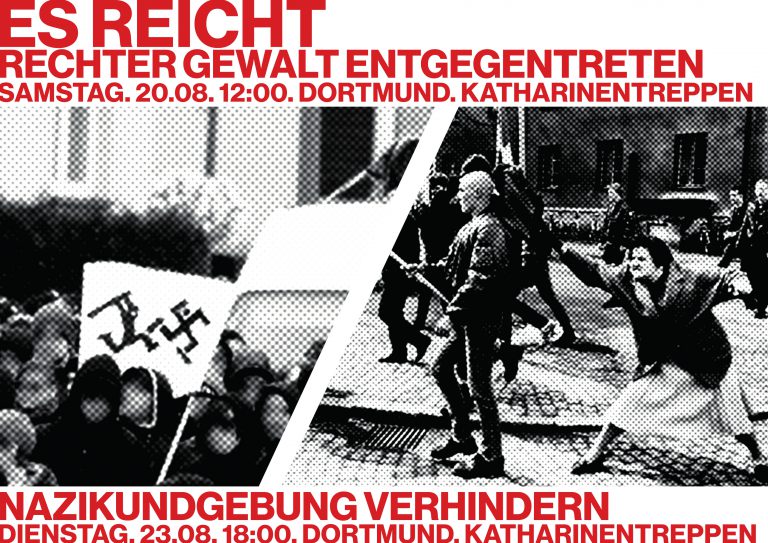
Wij, een alliantie van woordvoerders en losse activisten van verschillende antifascistische organisaties, linkse groepen, politieke partijen en vakbonden, roepen op voor een demonstratie in solidariteit met alle slachtoffers van extreem-rechts geweld. De demonstratie zal plaatsvinden op 20 augustus 2016 om 12:00 vanaf het Katharinentreppe (Dortmund Centraal Station) naar Dortmund-Dorsfeld, een wijk die door nazi’s geclaimed wordt als ‘hun terrein’. (Deze demonstratie heft inmiddels plaatsgevonden, zie o.a. hier voor een verslag)
Verdere acties:
23 augustus 2016, 18:00u: Acties tegen de nazi-demonstratie op de Katharinentreppe (Dortmund Centraal Station)
24 september 2016, 14:00u: Massademonstratie tegen rechts geweld in Dortmund
Solidariteit met Dortmund
Zondagmiddag vielen drie nazi’s met een mes een antifascist aan voor zijn huis in Dortmund. Het slachtoffer werd twee weken eerder door nazi’s bedreigd en had daar aangifte van gedaan bij de politie. Dit is waarschijnlijk de reden dat de nazis zijn adres wisten. Dat nazi’s op klaarlichte dag iemand aanvallen geeft blijk van hoe gevaarlijk de nazi-beweging in Dortmund is. Maar het laat ook zie hoeveel zelfvertrouwen de nazi’s hebben om dit soort daden te verrichten in de stad, en dat ze zich daar veilig bij voelen. De mogelijkheid dat de persoon die ze hierbij aanvielen zou worden vermoord werd hier duidelijk geaccepteerd.
Gebeurtenissen in Dortmund
De verhalen over bedreigingen en aanvallen van nazi’s in Dortmund stapelen zich de laatste tijd op. Maar het lijkt wel alsof niemand er iets om geeft. Men denkt blijkbaar dat er na het verbod op de nazi-organisatie „Nationaler Widerstand Dortmund“ genoeg is gedaan aan de lokale nazi-scene. Aan de kant van de gemeenteraad blijft het bij symbolische acties. De politie blijft zich inzetten om nazi-marsen ongestuurd doorgang te laten vinden. Antifascistische activiteiten worden gecriminaliseerd en constant gehinderd. Al sinds jaren is Dortmund een extreem-rechts bastion in Noordrein-Westfalen, en heeft een grote aantrekkingskracht op de nazi-scene in heel Duitsland.
Om succesvol te zijn in onze acties tegen deze situatie moeten wij volhardend, vastberaden en eensgezind zijn. Wij wensen hen die zich inzetten tegen nazi’s en racisme in Dortmund veel kracht en doorzettingsvermogen toe. Laat je niet intimideren! Maar kijk goed uit.
Wij zullen jullie blijven ondersteunen, zo veel wij kunnen. Wij sturen jullie solidaire groeten en hopen op een snel herstel van de verwonde antifascist.
Antifa café in Utrecht!
Internationale dagen van solidariteit met anarchistische & antifascistische gevangenen in Rusland
Op 3 juli organiseert Antifa Utrecht het eerste Antifa Café in Utrecht van 2016! Aangezien er al lange tijd geen Antifa Café is geweest in Utrecht willen we daar verandering in te brengen. We zijn van plan om na de zomer meer Antifa Café’s te organiseren!
Vanaf 16:00 ben je welkom in het ACU (Voorstraat 71, Utrecht) om daar deel te nemen aan:
– De workshop “Opkomst extreemrechts”
De opkomst van extreem rechts in Europa en Nederland is zorgwekkend. Hoe kunnen we de opkomst van deze groepen beter begrijpen?
– Een vertoning van de documentaire “Neonazis in Russland: Angriff der Schlägertrupps” engels ondertiteld.
Natuurlijk is er ook tijd voor koffie & thee en vegan snacks!
Voor meer updates: houd het Facebook-event in de gaten.
https://www.facebook.com/events/1040693479313364
Tot 3 juli om 16:00 @ ACU!
Antifa Utrecht
ENGLISH
Antifa café in Utrecht!
International days of solidarity with anarchist and antifascist prisoners in Russia
On July 3rd Antifa Utrecht organizes the first 2016 Antifa Café in Utrecht! Since there hasn’t been an Antifa Café in Utrecht for quite a while, we want to change that. We aim to continue organizing Antifa Cafés after the summer!
You’re welcome from 16:00 onwards in ACU (Voorstraat 71, Utrecht) to join:
– The workshop “The rise of extreme-right”
The rise of extreme right in Europe and the Netherlands is alarming. How can we understand the rising of these groups better?
– A screening of the documentary “Neonazis in Russland: Angriff der Schlägertrupps” englisch substiteld.
Of course there will be coffee & tea and vegan snacks!
For more updates: check our Facebook event.
[https://www.facebook.com/events/1040693479313364]
Op zaterdag 18 juni organiseert het extreem-rechtse Pegida Nederland een demonstratie in Breda gericht tegen vluchtelingen. Met een ‘mars’ door Breda vanaf het Kasteelplein willen ze hun verwerpelijke racistische en islamofobe gedachtegoed onder de aandacht brengen. Laat Ze Niet Lopen, een initiatief tegen racisme en extreem-rechts, roept op om in actie te komen tegen deze racistische optocht. Stop Pegida en haar extreem-rechtse achterban, houd racisten van de straat! Laat Ze Niet Lopen!
Pegida Nederland, een uit Duitsland overgewaaide islamofobe beweging, heeft de afgelopen maanden geprobeerd om onder de dekmantel van de ‘bezorgde burger’ hun verwerpelijke racistische gedachtegoed onder de aandacht te brengen. Pegida parasiteert de laatste tijd ook steeds vaker op lokaal protest tegen de komst van vluchtelingen, en wil nu onder het motto ‘Nederland zegt nee tegen AZC’ een landelijke demonstratie op touw zetten. Lokale protesten tegen vluchtelingen liepen de afgelopen maanden geregeld uit de hand. Opvanglocaties voor vluchtelingen werden aangevallen, maar ook moskeeën werden doelwit van onder andere brandaanslagen en bekladdingen.
Hoewel Pegida zich probeert te distantiëren van dit geweld, blijkt telkens weer dat de organisatie er veel radicalere intenties op na houdt dan dat ze aan het brede publiek willen laten blijken. Op eerdere demonstraties (oa in Utrecht, Rotterdam en Amsterdam) brachten Pegida aanhangers de Hitlergroet en vielen ze anti-racistische activisten, omstanders en journalisten aan. Pegida ontvangt op haar demonstraties organisatorische steun van extreem-rechtse groeperingen zoals DTG en Voorpost, en een groot deel van haar vaste deelnemers is afkomstig uit extreem-rechtse of neonazistische kringen. Een aantal weken geleden werd er op een door Pegida ondersteunde demonstratie in Utrecht tijden een toespraak nog opgeroepen om moskeeën in brand te steken. Dergelijke aanslagen worden op sociale media door Pegida-activisten openlijk toegejuicht.
In het alsmaar verrechtsende politieke klimaat in Nederland, waar verzet tegen de komst van vluchtelingen steeds radicalere en racistischere uitingen krijgt, is het een gevaarlijke ontwikkeling dat een organisaties als Pegida openlijk de ruimte krijgt om haar verwerpelijke gedachtegoed te verspreiden en te rekruteren. Laat Ze Niet Lopen, een initiatief tegen racisme, roept je daarom ook op om je te verzetten tegen Pegida en zelf actie te ondernemen tegen de komst van rechts-extremistische actievoerders. Organiseer jezelf en je vrienden, fluit ze uit, overstem ze, blokkeer, laat zien dat ze niet welkom zijn! Eerdere demonstraties van Pegida zijn door toedoen van tegenacties altijd vrij beperkt gebleven. Het is aan ons om samen de druk op de ketel te houden en de ruimte voor Pegida zo klein mogelijk te houden!
De demonstratie van Pegida begint om 14:00 op het Kasteelplein in Breda. Voor verdere informatie is het handig om de komende dagen www.laatzenietlopen.nl in de gaten te houden. Ook kan je ‘Laat Ze Niet Lopen’ volgen op Twitter en Facebook. Zie hier voor het Facebook-event. In de aanloop naar, en op de dag van het tegenprotest voorzien wij in de laatste informatie, kaartjes van de omgeving en infostructuur.
Kom 18 juni in actie en stop de opmars van extreem-rechts! Laat Ze Niet Lopen!
De komende demonstratie op zaterdag 21 mei te Sterrenwijk, Utrecht, die mede-georganiseerd is door de rechts-extemistische Nederlandse Volks-Unie (NVU), is voor Antifa Utrecht een reden om een tegengeluid te laten horen. Onder andere het nazistische karakter van NVU en de geschiedenis van nazisme in Utrecht zijn redenen voor Antifa Utrecht om deze demonstratie kritisch te benaderen.
De demonstratie werd aangekondigd als een samenwerking tussen NVU en de Facebookgroep ‘Zeg Nee Tegen Azc Gansstraat (Pieter Baan Centrum)’. De NVU, een nationalistische partij onder leiding van Constant Kusters, demonstreerde eerder dit jaar in Amsterdam waarbij zeven partijleden de hitlergroet brachten en hiervoor werden opgepakt door de Amsterdamse politie. Het nazistische en fascistische imago van de relatief jonge NVU is echter niet nieuw. Naar aanleiding van een demonstratie in 2011 zijn partijleden van de NVU onder andere veroordeeld voor het aanzetten tot haat en discriminatie.
De nationalistische partij wil aanstaande zaterdag de straten van Utrecht ingaan om hun onvrede te uiten over de komst van een asielzoekerscentrum in het Pieter Baan Centrum (PBC). Het PBC is formeel een Huis van Bewaring, wat zou betekenen dat vluchtelingen in een justitiële inrichting zullen worden ondergebracht. Antifa Utrecht is hier fel op tegen, zo zegt antifasciste Anna: “Vluchtelingen horen verwelkomd te worden, maar niet door neonazi’s die door de straten lopen.” Het debat over vluchtelingen is naar aanleiding van tegendemonstraties in Utrecht al eerder uit de hand gelopen. Anna: “Ik laat me niet afschrikken door de NVU.”
Vanuit historisch perspectief heeft Utrecht een problematische geschiedenis met nazi’s. Gedurende de Tweede Wereldoorlog marcheerden Duitse nazi’s Utrecht binnen om vervolgens panden aan de Maliebaan te vorderen. Het huidige Pieter Baan Centrum was toentertijd een gevangenis waar ondermeer Utrechtse verzetsstrijders onder het nazisme werden opgesloten. Op 21 mei 2016, 71 jaar nadat Utrecht nazivrij is gemaakt, wil de NVU marcheren in de straten van Utrecht. “Ze kunnen niet zomaar besluiten om het Pieter Baan Centrum weer te claimen met hun nazigedachtegoed.”
Antifa Utrecht roept antifascisten en Utrechters op om zich uit te spreken tegen de komst van de NVU. Anna: “Deze neonazi’s kunnen niet op een zaterdag opeens Utrecht in marcheren. We moeten er met zijn allen voor zorgen dat de NVU zich niet welkom voelt in Utrecht en in Sterrenwijk! Toen niet, nu niet, nooit meer fascisme!”
Afgelopen zondag demonstreerden zo’n 60 personen van het racistische Pegida Nederland in Den Haag, omringd door zo’n 200 politieagenten. Alleen het ‘creatief’ omgaan met de wet en een enorme repressiemacht weerhield massaal tegenprotest. In de ‘Stad van Recht en Vrede’ werd het recht op betoging voor de zoveelste maal ontnomen. Ondanks dat kwamen er mensen in verzet tegen Pegida, en lieten zij langs de route een tegengeluid horen.
Het was er de Haagse driehoek blijkbaar alles aan gelegen om de racistische demonstratie ruim baan te geven in de binnenstad. Uiteindelijk arresteerde de Haagse politie zondag 54 personen, waaronder enkele toevallige passanten en zelfs een minderjarig meisje.
Omdat er zich veel antifascisten op de route bevonden kon Pegida 45 minuten later dan gepland pas aan hun mars door de binnenstad van Den Haag beginnen. Antifascisten die vanaf het startpunt op het Spuiplein een tegengeluid lieten horen werden bij het artikel 1 monument aan de Hofplaats ingesloten door de ME en massaal gearresteerd. Ook zo’n 35 antifascisten die in een restaurant zaten langs de route werden binnen ingesloten door de ME. Ze werden gevorderd het pand waar ze zich in bevonden te verlaten, en werden vervolgens nog in het pand opgepakt voor het zogenaamd overtreden van de plaatselijke APV die het verbied samen te scholen. Samenscholen in een pand is überhaupt niet mogelijk en dat laat maar weer zien dat de politie en burgemeester van Den Haag preventief iedereen arresteert die zij verdenken van anti-racistisch gedachtegoed.
Dat Pegida demonstraties keer op keer een grotendeels bestaan uit bekende rechts-extremistische figuren mag geen geheim meer heten. In Den Haag was dat niet anders. Zo liep neonazi en NVU-lid Owen Koenekoop, gekleed in een trainingspak met white-power symboliek, met wat vrienden rond en verzorgde Voorpost-activist Florens van der Kooi de ordedienst. Zijn broer, de Breivik-fanaat Ben van der Kooi liep uiteraard ook mee, en neonazi Dennis de Vries maakte foto’s.
//platform.twitter.com/widgets.js
Sprekers op de Pegida demonstratie waren onder andere de extreem-rechtse Duitse politica Tatjana Festerling, ex NVU lid Hugo Kuiper en uiteraard wapenhandelaar en Pegida Nederland voorman Edwin Wagenveld. Ook Astrid ‘Asje Bello’ Visser mocht namens Pegida haar racistische gal spuwen op het Spuiplein.
Wij beraden ons inmiddels samen met onze advocaat op een gezamenlijke klachtenprocedure na aanleiding van het repressieve politieoptreden. Ben je afgelopen zondag opgepakt, houdt onze website en FB dan goed in de gaten.
Ondanks de enorme repressie van afgelopen zondag moeten we niet vergeten dat alleen door onze tegendruk de ruimte voor Pegida steeds klein blijft. Het lukt Pegida telkens niet om hun racistische gedachtegoed te verspreiden zonder beschermd te moeten worden door een overmacht aan politie. Typerend is dat ze na afloop van de demo op social media de Haagse politie uitvoerig bedanken voor de ‘samenwerking’.
Ondanks politierepressie zullen wij ook de volgende keer weer tot actie oproepen omdat overal waar racisme de kop op steekt een tegengeluid meer dan nodig is.
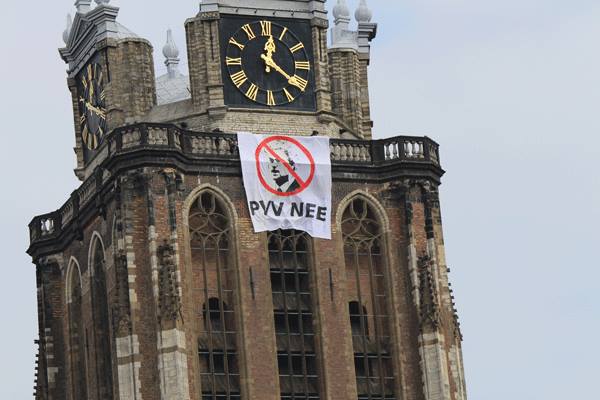
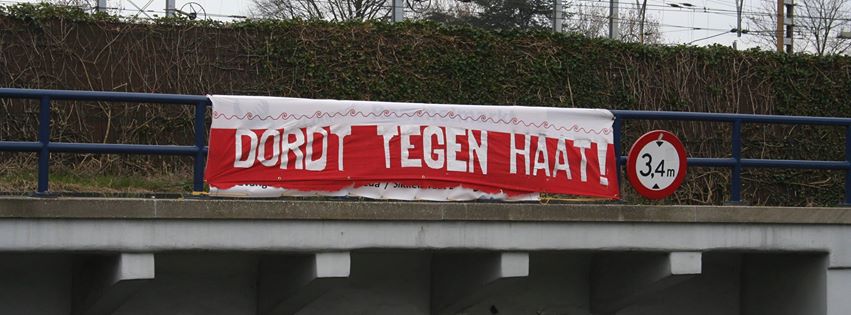
Vandaag bracht Geert Wilders een bezoek aan Dordrecht, om daar te flyeren in het kader van het referendum over het associatieverdrag tussen de EU en Oekraine. Gisteren werd Wilders Maastricht al uitgejaagd, en ook vandaag in Dordt kon hij rekenen op antifascistisch verzet tegen zijn racistische propaganda. Al dagen van tevoren werden er duizenden anti-Wilders stickers en anti-racistische posters geplakt. Bij zijn komst vanmiddag werden er verschillende spandoeken opgehangen en kwamen er tientallen mensen op straat in actie. Hieronder een verslag van ‘Dordt Discriminatie Vrij’:
‘Geen plek voor haat, angstzaaierij en uitsluiting in Dordrecht’
Met vier spandoeken, op de Grote Kerk, de Krispijntunnel en de Zwijndrechtse brug, hebben bezorgde Dordtenaren geprotesteerd tegen de komst van Geert Wilders naar Dordrecht. Daarnaast werden er flyers uitgedeeld op de markt en zijn op veel plekken stickers geplakt. Binnenstad bewoner Johan laat desgevraagd weten dat hij blij is met deze actie, omdat hij vindt dat er geen ruime is voor de uitsluiting waar Wilders voor pleit, ‘In Dordrecht is iedereen welkom en lossen we problemen samen op in plaats van mensen weg te sturen of niet meer mee te laten doen.
Door deze geslaagde actie is duidelijk aangegeven dat er geen plek is voor haat, uitsluiting of racisme in Dordrecht. Bij monde van actievoerder Raymond laat de organisatie weten dat zij zich blijven verzetten tegen haatzaaiers als Geert Wilders, maar tegelijkertijd zich ook in willen zetten voor een socialer Dordrecht en Nederland waar iedereen welkom is.
Actievoerder Sanne Hunzing zegt dat ze blij is met de actie, ‘Wij waren met een klein groepje, maar zoveel mensen deden uit zichzelf mee. Ik wil iedereen bedanken en hopelijk zijn de vijf arrestanten snel vrij!’
Ook vandaag was de flyeractie van Wilders door toedoen van tegenprotest geen succes. Ook in Dordrecht: racisten en fascisten niet welkom!

 Aanstaande zondag (9 oktober 2016) wil de extreem-rechtse beweging Pegida Nederland weer demonstreren in Den Haag. Wij hebben besloten om bij deze demonstratie slechts een minimale informatiestructuur op te zetten. Als mensen toch van plan zijn in actie te komen tegen Pegida dan moedigen wij dat uiteraard van harte aan. Voor deze mensen hebben wij aanstaande zondag wel een arrestantengroep en een advocaat paraat staan.